Table of Contents
- Why Live Brass Bands Transform Corporate Galas
- Brass Band Event Setup Requirements: Logistics and Planning
- Brass Band Song List for Events: Choosing the Right Repertoire
- Brass Band Performance Length: How Long Should They Play?
- Questions to Ask a Live Band Before Booking
- Insurance, Contracts, and Professional Vetting for Brass Bands
- Integrating Brass Bands into Your Gala’s Event Flow
- Frequently Asked Questions
Last Updated: October 7, 2026
Why Live Brass Bands Transform Corporate Galas
Hiring professional brass bands for corporate galas changes the room in a way a playlist never will. A brass ensemble is a group of horn players, typically trumpet, trombone, saxophone, and sousaphone or tuba, that performs live music without a large stage setup. When those instruments hit a ballroom, guests stop checking their phones and start moving toward the dance floor.
At New Orleans Music Events, we have spent more than 40 years producing live entertainment for corporate conferences and private celebrations, and we have watched this effect repeat itself across hundreds of rooms. The energy is physical. A trumpet cuts through conversation, a sousaphone anchors the beat in your chest, and a second-line groove pulls people out of their seats.
Below, we break down the logistics, repertoire, timing, and contracts you need to book a brass band that fits your gala, not just fills a corner.
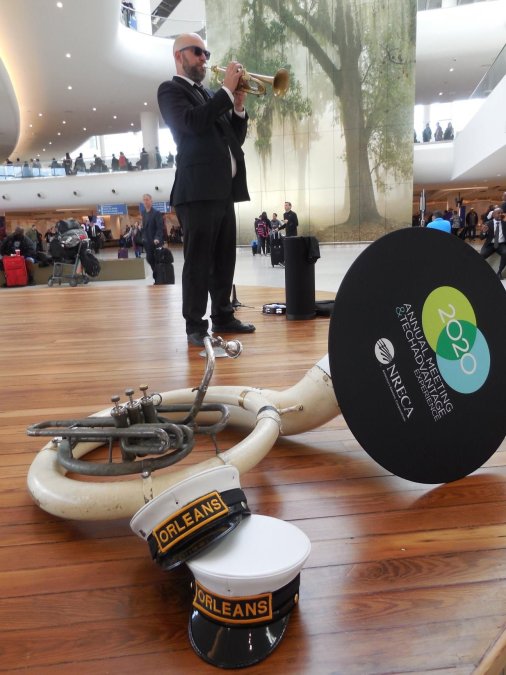
Live brass is the single fastest way to shift a formal gala from polite networking into genuine celebration. The instruments are loud, portable, and built to move through a crowd.
Brass Band Event Setup Requirements: Logistics and Planning
Brass band event setup requirements come down to three things: space, power, and timing. A four- to six-piece ensemble needs roughly 100 to 150 square feet of level floor, one standard 20-amp circuit for any amplified instruments or a small PA, and a 45- to 60-minute window for load-in and sound check. A full second-line section of eight to ten players needs closer to 200 to 250 square feet and a clear parade route if the band will move through the room.
The biggest decision most planners face is acoustic versus amplified. An acoustic brass band needs no power at all, which makes it ideal for cocktail hours, parade routes, and rooms where a full PA system would overwhelm the space. An amplified setup lets you place the band further from the audience and control volume for a seated dinner, but it adds a sound engineer, a mixer, and a monitor or two to your stage plot.
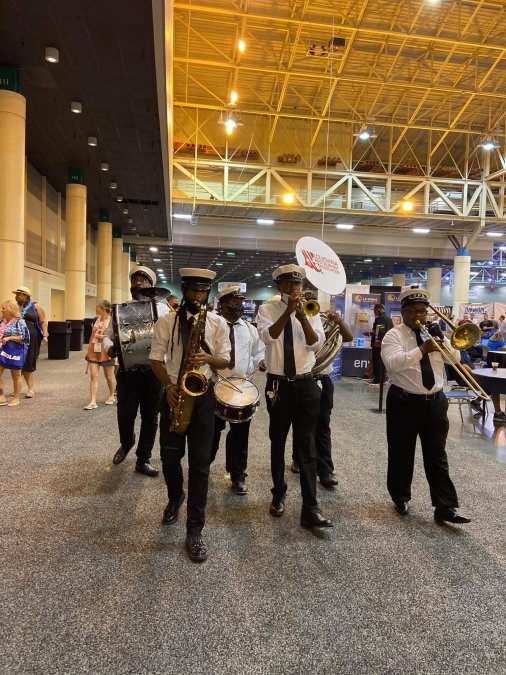
Here is the tech rider checklist we send to every venue before a gala. Ask any band you are considering for the same document:
- Stage or floor space: 100-250 sq ft, level, with a minimum 8 ft ceiling clearance for standing horn players
- Power: one dedicated 20-amp circuit within 25 ft of the performance area; no shared circuits with catering or lighting
- Sound: house PA with 2-4 vocal mics and 2 DI channels if amplified; fully acoustic if not
- Lighting: basic stage wash, no strobes or haze unless cleared with the venue
- Load-in: freight elevator dimensions, dock height, and the venue’s union labor contact
- Curfew: the hard time amplified sound must stop, in writing
- Green room: a secure, climate-controlled space for instrument cases and breaks
A common mistake is booking the band before confirming the venue’s load-in rules. Many hotels and event halls have union labor requirements, freight elevator schedules, and hard curfews for amplified sound. Confirm all three before you sign anything. If the venue requires union stagehands, your band’s load-in time can double, and that cost lands on your event budget, not the band’s.
If you skip the venue’s load-in requirements, you can end up paying for labor hours the band never uses or missing your sound check entirely. That delay pushes directly into your welcome reception.
Send the tech rider to the venue at least 30 days out and get a signed acknowledgment back. That single email prevents most day-of setup surprises.
Brass Band Song List for Events: Choosing the Right Repertoire
A strong brass band song list for events mixes three categories: recognizable crowd-pleasers, New Orleans standards, and one or two custom moments tied to your brand or program.
The repertoire is where a band proves its musical versatility. Ask for a written list, not a verbal promise. A professional ensemble should be able to move from a traditional second-line groove into a jazz standard, then into a modern pop arrangement, without losing the room.
For corporate galas, we recommend building the set in three blocks:
- Arrival and cocktail hour: low-key jazz standards and soulful instrumentals
- Dinner and program: mid-tempo grooves that support conversation
- Dancing and send-off: high-energy party band material and a second-line finale
Here is a simple framework we use when matching repertoire to event flow:
| Gala Phase | Repertoire Style | Energy Level | Typical Duration |
|---|---|---|---|
| Cocktail hour | Jazz standards, soul instrumentals | Low | 45-60 min |
| Dinner service | Mid-tempo grooves, light funk | Medium | 45-60 min |
| Program and awards | Instrumental intros, stings | Medium | 10-20 min |
| Dancing and finale | Party band, second-line | High | 60-90 min |
If your gala has a theme, tell the band early. A tribute performance or a custom arrangement tied to your brand takes rehearsal time, and you want it locked in weeks ahead, not days.
Brass Band Performance Length: How Long Should They Play?
The ideal brass band performance length for a corporate gala is 45 to 60 minutes per set, with a 15- to 20-minute break between sets. Most galas book two or three sets across the evening, which keeps the energy fresh and gives guests a natural pause for dinner or speeches.
Performance duration depends on your event flow, not on how long the band is willing to play. A band that plays continuously for three hours will fade, and so will your audience. Short, high-energy sets land better than one long marathon.
For a parade element or a second-line send-off, plan for 15 to 30 minutes of continuous movement. That is enough to move guests from one space to another without exhausting them.
Book your band for one set more than you think you need. If the room is still going at the end of the night, you can extend. If it is not, you simply end on time with no penalty.
Questions to Ask a Live Band Before Booking
The right questions to ask a live band before booking cover personnel, insurance, equipment, and references. Ask them in writing, and ask them early. The answers tell you more about professionalism than any promotional video.
Start with these:
- How many instrumentalists are in the ensemble, and can you scale up or down?
- Do you carry general liability insurance, and can you provide a certificate?
- What is your standard contract, and what are the cancellation terms?
- Can you provide references from corporate events similar in size to ours?
- Who handles sound, lighting, and stage requirements on the day?
- How do you handle travel expenses and out-of-state bookings?
A band that answers all six clearly, in writing, is a band you can trust with a 2,000-person gala. A band that deflects or delays is a risk you cannot afford.
According to guidance from the U.S. Small Business Administration on vendor contracts, a written agreement that spells out deliverables, payment terms, and cancellation policy protects both parties. Treat your entertainment contract the same way you treat any other vendor agreement.
Insurance, Contracts, and Professional Vetting for Brass Bands
Insurance and liability requirements are the part of booking that most planners underestimate. Any professional brass band performing at a corporate venue should carry general liability coverage, and many venues will not allow load-in without a certificate of insurance on file.
Ask the band to name your company and the venue as additional insured on the COI. That endorsement means if a guest is injured by a falling mic stand or a stray trombone slide, your company’s policy is not the first line of defense. Most corporate risk managers will not approve a vendor without it.
The vetting process for corporate professionalism goes beyond insurance. Ask for:
- A current certificate of insurance naming your company or venue as additional insured
- Signed contracts for every instrumentalist, not just the bandleader
- A clear technical rider listing sound, power, and stage requirements
- References from at least two corporate clients in the past 12 months
- A written dress code commitment that matches your gala’s formality
- A confirmed repertoire list with no profanity or off-brand material
Screen for punctuality the same way you screen for talent. Ask past clients whether the band arrived before call time, whether the bandleader communicated clearly in the weeks leading up to the event, and whether the group adapted when the run of show shifted.
A common pattern among planners who get burned is hiring on price alone. The cheapest quote often excludes insurance, travel, and a sound engineer, and those line items reappear as change orders the week of the event. Compare quotes on a like-for-like basis: same ensemble size, same set length, same insurance and travel terms.
This is where a booking agency or a full-service production partner earns its fee. When you work with a team that handles contracts, insurance, and event coordination in one place, you are not chasing paperwork across six freelancers the week before your gala.
Verbal agreements and handshake deals are the most common cause of gala entertainment failures. If it is not in the contract, it does not exist on event day.
A COI with your company named as additional insured, a signed contract for every player, and two recent corporate references are the three non-negotiables before you release a deposit.
Integrating Brass Bands into Your Gala’s Event Flow
Integration with event flow is what separates a good band from a great gala. The band should not be an add-on at the end of the night. It should be woven into the arc of the evening from the first guest arrival to the final send-off.
Here is how we approach it at New Orleans Music Events. We map the band’s sets against your run of show, then build transitions around the moments that matter: the welcome, the award presentation, the keynote, and the finale. A short brass sting can signal the start of the program. A second-line can move guests from the ballroom to the after-party.
This is also where custom branding integration pays off. For planners who want one team to cover the whole production, our Music, entertainment, parades, decor, event production services can carry a gala from the first note to the final send-off.
The result is a gala that feels designed, not assembled. Guests remember the moment the horns came through the doors, not the centerpiece on table 14.
Planning a corporate gala means juggling a hundred moving parts, and live entertainment should not be one of them. New Orleans Music Events brings more than 40 years of experience producing brass bands, parades, and full event production for corporate conferences and private celebrations across the country. From custom branding to technical management, our team handles every detail so your gala runs seamlessly from load-in to send-off.
Frequently Asked Questions
How much does it cost to hire a brass band?
Pricing for a brass band depends on several factors, including the number of musicians, performance duration, travel distance, and any custom arrangements. For a corporate gala, you’ll typically receive a quote based on your specific event needs. Contact the band directly to discuss your budget and get an accurate estimate.
What should you ask a brass band before booking?
Ask about their experience with corporate galas, their full repertoire, performance length options, setup and sound requirements, insurance coverage, and whether they can accommodate custom branding or specific song requests. Also confirm their cancellation policy and what happens if a musician is unavailable.
Can a brass band play during a cocktail reception and dinner?
Yes, many brass bands offer flexible performance formats. They can play acoustic sets during a cocktail hour, transition to amplified music for dinner, and then shift to high-energy dance sets. Discuss the schedule with the band in advance so they can plan their instrumentation and sound setup accordingly.
How long should a brass band perform at a corporate gala?
A typical performance runs 45 to 60 minutes per set, with breaks in between. For a three-hour gala, two or three sets work well. The band can also provide continuous background music during dinner. Confirm the total performance duration and any overtime rates in your contract.