
Table of Contents
- Building a Strategic Event Framework for Large Scale Events
- Large Scale Event Risk Management and Emergency Response
- Crowd Control Best Practices for Events with Thousands of Attendees
- Event Production Logistics Checklist for Seamless Execution
- Stakeholder Coordination and Communication Strategy
- Sustainability and Hybrid Integration for Modern Large Scale Events
- Post-Event Analysis and Data-Driven Insights
- Conclusion: Elevating Your Next Large Scale Event
- Frequently Asked Questions
Last Updated: September 21, 2026
Building a Strategic Event Framework for Large Scale Events
Best practices for large scale events start with a single discipline: define what success looks like before you book anything. According to the Event Safety Alliance’s guidance on event planning, the most common failure point in major events is unclear ownership of objectives, not budget or logistics.
Defining Logistical Objectives and KPIs
Logistical objectives describe what the event must physically accomplish: move 2,000 attendees through registration in under 30 minutes, seat a gala dinner by 7:15 p.m., or run a product launch with zero AV downtime.
KPIs measure whether you hit them. Track a small set:
- Registration throughput per hour
- Session attendance versus RSVP rate
- Vendor on-time arrival percentage
- Attendee engagement scores from post-event surveys
- Cost per attendee against budget allocation
Goal Hierarchy: Business, Event, and Operational Objectives
Experienced producers separate goals into three tiers; mixing them means optimizing for the wrong thing.
- Business objectives answer why the event exists: generate qualified pipeline, launch a product to press and analysts, retain top clients, or raise a target amount for a cause. Owned by the executive sponsor.
- Event objectives translate business goals into attendee outcomes: 60% of attendees book a demo, 80% rate the keynote as valuable, 500 unique press mentions. Owned by the event director.
- Operational objectives are the physical and logistical targets your production team owns: registration throughput, load-in completion, AV uptime, catering service windows.
Stakeholder Mapping and Decision Rights
A framework only works if decision rights are explicit. Build a RACI-style map, Responsible, Accountable, Consulted, Informed, for each major workstream: production, registration, hospitality, entertainment, sponsorship, and communications.
Budget Allocation and Resource Planning
Budget allocation for large scale events splits across venue, production, entertainment, catering, staffing, and contingency. Reserve a meaningful contingency line rather than distributing every dollar to line items, because change orders during load-in are where budgets break. Resource allocation follows the same logic: one owner per functional area, each with authority to make on-site calls up to a defined threshold.
Build your contingency line before you negotiate with vendors, not after. Once contracts are signed, every unplanned expense comes out of someone’s margin, and that someone is usually you.
Planning Timeline and Milestone Gates
A framework without a timeline is a wish list. Anchor the plan to milestone gates that force decisions at the right moment:
| Gate | Typical Timing | Decision Required |
|---|---|---|
| Concept approval | 9-12 months out | Business objectives, budget envelope, date hold |
| Venue and vendor lock | 6-8 months out | Contracts signed, contingency funded |
| Program and run-of-show draft | 3-4 months out | Speaker roster, session grid, sponsor deliverables |
| Logistics freeze | 6-8 weeks out | Load-in schedule, staffing plan, final headcount |
| Final walkthrough | 1-2 weeks out | Run-of-show locked, crisis plan rehearsed |
Large Scale Event Risk Management and Emergency Response
Large scale event risk management is the process of identifying, ranking, and mitigating the operational, safety, financial, and reputational threats that could disrupt an event. It is a living plan reviewed at every milestone, not a document you file and forget.
Conducting a Comprehensive Risk Assessment
A comprehensive risk assessment scores each risk by likelihood and impact, then assigns a mitigation owner. The categories that matter most for large gatherings:
- Crowd and safety risks: overcrowding at entry points, medical incidents, severe weather
- Operational risks: vendor no-shows, AV failure, power loss, union labor disputes
- Financial risks: ticket refund exposure, sponsor withdrawal, currency or contract disputes
- Reputational risks: security incidents, guest misconduct, social media backlash
Crisis Communication Templates and Contingency Planning
Crisis communication templates are pre-written message frameworks your team can adapt in minutes when something goes wrong. Draft templates for the scenarios your risk assessment flagged: medical emergency, venue evacuation, keynote cancellation, weather delay, and security incident. Each needs a holding statement, a stakeholder notification list, and a designated spokesperson.
The mistake that sinks events is treating the crisis plan as a document rather than a rehearsal. If your team has never walked through an evacuation scenario or read the holding statement aloud, the plan will fail when it matters.
Crowd Control Best Practices for Events with Thousands of Attendees
Venue Capacity and Site Layout Optimization
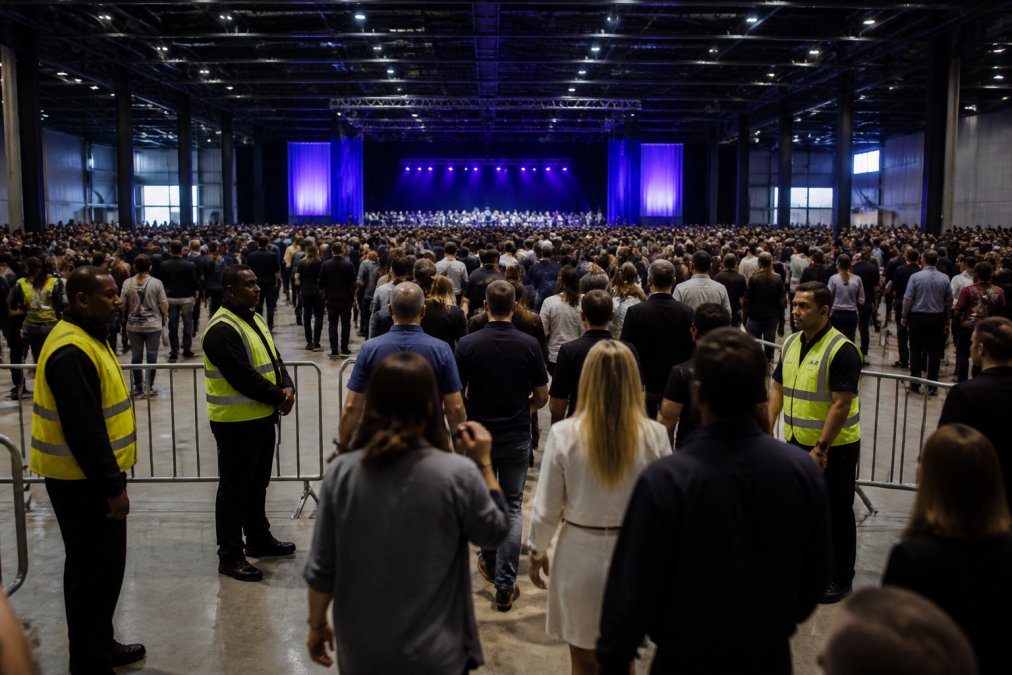
Site layout optimization means designing the path attendees take from arrival to departure, then testing it against expected peak load. Key decisions:
- Separate entry and exit lanes so arriving and departing crowds never cross
- Position registration away from main entrances to prevent bottlenecking
- Keep emergency egress routes clear and marked, and brief staff on them
- Place high-demand attractions (bars, headline stages, photo moments) away from choke points
Flow Rate Math: Sizing Entrances, Exits, and Queues
Most crowd incidents trace back to a planner who sized a doorway by feel rather than throughput. The working numbers practitioners use:
- A single standard door with a metal detector or bag check processes roughly 200-400 people per hour depending on screening level.
- A walk-through lane with no screening moves closer to 600-900 people per hour.
- A bank of 10 check-in stations, each handling one attendee every 30 seconds, clears about 1,200 people per hour.
Post-Pandemic Crowd Dynamics and Attendee Flow
Post-pandemic crowd dynamics shifted in ways planners still underestimate: attendees arrive earlier and linger longer near entry points, prefer more personal space in queues, and move toward exits faster when sessions end. Design your flow plan for these behaviors, not pre-2020 assumptions.
Practical adjustments:
- Widen queue lanes; a lane that felt comfortable in 2019 now reads as crowded.
- Add more check-in stations than capacity math alone suggests, because dwell time at entry has increased.
- Stagger session end times so 2,000 people are not released into a corridor simultaneously.
- Post clear signage at every decision point; attendees who pause to read create eddies that ripple backward into the queue.
- Keep hand-sanitizing stations and ventilation visible; attendees read these as signals the organizer is paying attention, which reduces anxiety-driven crowding.
Staffing, Signage, and Real-Time Monitoring
Crowd control is a staffing and information problem as much as a physical one. Patterns that hold up across venue types:
- Ratio staffing: Roughly one trained staffer or volunteer per 100-150 attendees for general flow, with denser coverage at entry, bars, and stage fronts.
- Radio protocol: Assign each zone a call sign and a single channel. Zone leads report density changes on a fixed cadence, not only when something goes wrong.
- Signage hierarchy: Directional signage should be readable from 30 feet, color-coded by destination, and repeated at every junction. If an attendee has to ask where to go, the signage failed.
- Real-time monitoring: For events above a few thousand attendees, use ticket-scan data, Wi-Fi association counts, or camera-based density tools to watch flow in real time. Catch a stall in the first 60 seconds, not after it becomes a safety issue.
The mistake that sinks crowd plans is treating density as a static number. Crowds are dynamic; the plan has to include a trigger for when to open a second lane, redirect a queue, or pause entry until a bottleneck clears. Write those triggers down and rehearse them.
Event Production Logistics Checklist for Seamless Execution
An event production logistics checklist is the master document sequencing every task from vendor confirmation through load-out, the single most useful artifact you will build.
Vendor Procurement and On-Site Coordination
Vendor procurement for large scale events should close earlier than most planners expect. Contracts, certificates of insurance, and load-in schedules must be locked before the final month, because late vendor changes cascade into every downstream task. On-site coordination depends on a single point of contact per vendor and a shared run-of-show everyone works from.
Union Load-In Requirements and Event Timeline Management
Union load-in requirements vary by venue and city, and getting them wrong is expensive. Before signing a venue contract, confirm which trades are represented, what the work rules require, and how many union stewards your crew size triggers. Build the event timeline backward from load-in windows, not forward from your ideal schedule.
| Phase | Typical Timing | Owner |
|---|---|---|
| Vendor contracts locked | 6-8 weeks out | Procurement lead |
| Union load-in schedule confirmed | 4 weeks out | Production manager |
| Run-of-show finalized | 2 weeks out | Event director |
| On-site rehearsal | 1 day prior | Technical director |
| Load-out | Within venue window | Production manager |
Stakeholder Coordination and Communication Strategy
Stakeholder coordination fails when communication is ad hoc. Define a communication strategy with named channels, cadences, and escalation rules before planning begins. For a 2,000-person event, expect stakeholders across the host organization, venue, vendors, sponsors, and any DMC or entertainment partner. Give each group one point of contact on your team, and keep a shared status document updated on a fixed schedule.
The events that run cleanly are not the ones with the fewest problems. They are the ones where every stakeholder knows exactly who to call and what happens next.
Sustainability and Hybrid Integration for Modern Large Scale Events
Sustainability and hybrid integration are where most large scale event guides fall short, and where attendee and sponsor expectations have moved fastest. On sustainability, track what you can measure: waste diverted from landfill, food surplus donated, energy consumption, and travel emissions. Set targets before the event, not after.
Post-Event Analysis and Data-Driven Insights
Post-event analysis converts a single event into compounding improvement. Within two weeks of load-out, run a structured debrief with every functional owner and pull your KPI data into one report.
Conclusion: Elevating Your Next Large Scale Event
Running a large scale event well comes down to preparation most teams skip: written objectives, a rehearsed crisis plan, and a logistics checklist everyone works from. New Orleans Music Events brings over 40 years of production experience, full-service event production including decor and technical management, live music and brass band entertainment, and custom branding integration that weaves your brand into the experience itself.
Frequently Asked Questions
What are the 5 C’s of event management?
The 5 C’s are a framework for successful large scale events: Concept (the core purpose), Coordination (aligning vendors and stakeholders), Control (managing crowds and logistics), Communication (clear messaging to all parties), and Contingency (backup plans for emergencies). Applying these principles helps ensure your event stays on track from planning through execution.
How do you mitigate risk during large-scale event planning?
Mitigating risk starts with a thorough risk assessment covering weather, security, vendor failures, and medical emergencies. Create an emergency response plan and share it with all stakeholders. Secure event insurance, establish clear communication channels, and build contingency buffers into your event timeline. For large scale events, conducting a tabletop exercise with your core team before the event can reveal gaps in your planning.
What are the key logistical challenges in large-scale event production?
Key challenges include managing union load-in and load-out schedules, coordinating multiple vendors across venues, ensuring adequate power and technical infrastructure, and handling attendee flow without bottlenecks. Resource allocation for staff, security, and equipment must be precise. An event production logistics checklist helps track these moving parts and prevents last-minute surprises that can derail your event timeline.
How do you manage crowd control for large-scale events?
Crowd control requires a combination of venue capacity planning, clear signage, trained staff, and real-time monitoring. Use barrier systems to guide attendee flow, stagger entry times if possible, and maintain wide emergency exits. For events with thousands of attendees, coordinate with local law enforcement and have a dedicated on-site coordination team. Post-pandemic crowd dynamics also mean considering touchless entry and health protocols.
What role does technology play in modern large scale event management?
Technology supports registration, check-in, attendee engagement, and data-driven insights. Event management software can track KPIs, manage vendors, and send real-time alerts. For hybrid events, streaming platforms and virtual integration tools extend your reach. Technology also aids crowd control through heat mapping and mobile apps that push updates to attendees, improving the overall attendee experience.
How can I incorporate sustainability into a large scale event?
Sustainability efforts can include digital ticketing to reduce paper waste, locally sourced catering to lower carbon footprint, recycling stations, and carbon footprint tracking. Choose venues with energy-efficient systems and offer shuttle services to reduce individual car use. Communicating these initiatives to attendees also strengthens your brand’s environmental commitment.