
Table of Contents
- What Expert Event Management for Large Corporate Gatherings Means
- Building Your Corporate Event Planning Checklist
- Creating an Event Production Timeline That Works
- Developing Your Corporate Event Run of Show
- Large Event Risk Management and Contingency Planning
- Measuring Event ROI and Business Impact
- Why Professional Event Management Delivers Results
- Frequently Asked Questions
Last Updated: October 5, 2026
What Expert Event Management for Large Corporate Gatherings Means
Expert event management for large corporate gatherings is the strategic coordination of every detail, from logistics to entertainment, that transforms a corporate event into a seamless, memorable experience. At New Orleans Music Events, we know managing large-scale events demands deep experience, meticulous planning, and the ability to handle unexpected challenges with confidence.

Coordinating 2,000 attendees across multiple venues, managing union load-ins, and ensuring flawless technical execution means the stakes are high. A single misstep, a late speaker, failed audio, entertainment that misses the mark, can undermine months of planning and damage your brand.
The difference between a good event and an expertly managed one comes down to preparation, contingency planning, and professionals on-site who solve problems in real time.
Expert event management is about controlling every variable so your attendees experience seamless execution, authentic engagement, and the exact brand message you intended.
Building Your Corporate Event Planning Checklist
A comprehensive corporate event planning checklist keeps your team aligned. Start with these core phases:
Pre-Event Planning Phase
Planning begins months before the event:
- Define event goals aligned with business objectives
- Identify your target audience and their needs
- Establish your budget and secure stakeholder approval
- Select your venue and lock in dates
The pre-event phase typically runs 6-12 weeks out, when you make the strategic decisions that shape everything else.
Create a shared project management tool where all stakeholders can track progress. This reduces miscommunication and keeps everyone accountable for their deliverables.
Logistics and Vendor Coordination Phase
Once foundational decisions are made, logistics take center stage, intensifying 4-6 weeks before the event:
- Finalize vendor contracts and confirm service details
- Coordinate load-in schedules and union requirements
- Manage room setup and floor plan logistics
- Confirm speaker travel, accommodations, and technical needs
Union requirements directly impact your timeline and budget, getting them wrong creates cascading delays on event day.
Creating an Event Production Timeline That Works
Your event production timeline is the backbone of coordination. Start with your event date and work backward. A typical timeline includes:
| Phase | Timing | Key Activities |
|---|---|---|
| Strategic Planning | 12+ weeks before | Goals, budget, venue, team assembly |
| Vendor Coordination | 8-10 weeks before | Contracts, confirmations, logistics planning |
| Content Development | 8-6 weeks before | Agenda, speaker coordination, messaging |
| Technical Setup | 4-2 weeks before | AV specs, run-of-show, rehearsals |
| Final Preparations | 1 week before | Confirmations, contingency review, team briefings |
| On-Site Execution | Event day | Setup, rehearsals, live event management |
| Post-Event | 1-2 weeks after | Breakdown, evaluations, reporting |
Include specific dates, responsible parties, and dependencies. For large events, dependencies matter: if speaker bios aren’t finalized by week 6, printed materials slip, affecting registration communications and attendance projections. Build in buffer time, if your venue needs 4 hours for setup, schedule 5. These buffers absorb small delays that compound into major problems.
Developing Your Corporate Event Run of Show
Your run of show is the minute-by-minute schedule that guides your entire event team, ensuring every department knows exactly what’s happening and when.
A strong run of show includes:
- Time stamps for every segment (doors open, welcome remarks, breakout sessions, meals, entertainment)
- Responsible parties for each segment (who’s running it, who’s supporting, who’s timing)
- Technical cues (lighting changes, video playback, audio levels, music transitions)
- Speaker introductions and transitions
Agenda Development and Speaker Coordination
Effective speaker coordination means:
- Confirming speaker availability and technical requirements 6 weeks before the event
- Providing clear guidelines on talk length, format, and messaging
- Scheduling speaker rehearsals at least 1 week before the event
- Creating speaker packages with travel, accommodation, and logistics details
The common mistake is treating speakers as interchangeable.
Technical Production and Audio-Visual Setup
Your technical setup is where most large events succeed or fail. Poor audio, missing video cues, or off-brand lighting undermines everything else.
Technical production includes:
- Audio system design and testing (microphones, speakers, monitoring)
- Video playback and projection management
- Lighting design that supports your brand and mood
- Live streaming or recording setup (if applicable)
For large corporate gatherings, we recommend dedicated technical staff on-site throughout the event.
Large Event Risk Management and Contingency Planning
Most planners focus on what they want to happen. Experts focus equally on what might go wrong.
Build a Risk Register, Not a Risk List
A risk register ranks threats by likelihood and impact, assigns an owner, and defines a trigger. A three-tier scale works for most gatherings:
| Likelihood | Impact | Response Tier |
|---|---|---|
| Low | Low | Monitor; no pre-built response needed |
| Medium | Medium | Documented backup; owner on call |
| High | High | Rehearsed contingency; decision-maker on-site |
For each high-tier risk, write three things: the trigger, the decision-maker, and the first three actions.
Run a Tabletop Exercise Two Weeks Out
A tabletop exercise is a 60- to 90-minute walkthrough where your core team talks through three or four high-tier scenarios without executing them.
The most common contingency mistake is having a plan but not communicating it to your team. Every team member should know their role in the contingency response. Practice it before the event.
Crowd Management and Capacity Planning
Large gatherings introduce crowd dynamics small events never face. Work with your venue and local authorities to establish:
- Maximum occupancy per room and per floor, with real-time headcounts at entrances
- Clearly marked egress routes that stay unobstructed even during peak traffic
- Trained crowd managers positioned at choke points (entrances, escalators, session transitions)
- A communication protocol between security, venue staff, and your event team
- A reunification point for separated groups, especially for events with families or guests with mobility needs
Emergency Response and Medical Support
Every large gathering needs a written emergency action plan covering fire, severe weather, medical incidents, and security threats. Key elements:
- A designated incident commander who has authority to pause or stop the event
- A first aid station staffed during all event hours, with a documented route for emergency medical services
- Pre-briefed ushers and volunteers who know how to summon help without causing panic
- A public address script for each emergency type, approved in advance by your legal and communications teams
- A post-incident reporting process so every near-miss becomes a lesson for the next event
Cybersecurity and Data Protection
Registration systems, attendee apps, and Wi-Fi networks are all entry points. Before the event:
- Confirm that your registration vendor encrypts data in transit and at rest
- Require multi-factor authentication for all admin accounts
- Segment your event Wi-Fi so attendee traffic cannot reach your production network
- Have a printed backup of the attendee list and run of show in case systems go down
- Brief your team on phishing and social engineering tactics that target event staff
Weather and Travel Contingencies
For events with outdoor components or significant travel, build decision points into your timeline.
Accessibility as a Risk Category
Accessibility failures are risk events. If a wheelchair user cannot reach a session room, or a Deaf attendee has no interpreter for a keynote, that is a planning failure, not an unavoidable surprise. Build accessibility into your risk register with the same rigor as technical failures:
- Confirm step-free routes to every session room, restroom, and dining area
- Book ASL interpreters and captioning vendors early, they are often the first to sell out
- Collect dietary and sensory needs during registration, not on-site
- Designate a quiet room for attendees who need a break from noise and crowds
- Test your event app and website with screen readers before launch
Assign one person to own accessibility end-to-end. When accessibility is everyone’s job, it becomes no one’s job.
Building these elements in from day one is far easier than retrofitting them later, and it signals to attendees that you value their participation and safety.
Measuring Event ROI and Business Impact
You’ve invested months of planning and significant budget. Now measure whether the event delivered business results.
Start With Objectives, Then Choose KPIs
Every event objective should map to at least one measurable KPI.
A Practical KPI Framework
| Objective | Primary KPI | Secondary KPI |
|---|---|---|
| Lead generation | Qualified leads captured | Cost per qualified lead |
| Customer retention | Post-event renewal rate | Attendee NPS vs. non-attendee NPS |
| Brand awareness | Unaided recall lift | Share of voice during event window |
| Product launch | Demo requests | Feature adoption within 90 days |
| Employee engagement | Session attendance rate | Post-event engagement survey score |
Cost Per Outcome, Not Just Cost Per Attendee
Cost per attendee is a useful baseline, but it hides whether the event worked.
Measure Before, During, and After
- Before: Send a pre-event survey to registrants to establish a baseline for awareness, intent, and expectations. This becomes your comparison point.
- During: Track session attendance, Q&A participation, app engagement, networking interactions, and booth scans in real time. Real-time dashboards let you adjust the next day’s programming.
- After: Send a post-event survey within 48 hours while the experience is fresh. Follow up at 30 and 90 days to measure lead conversion, renewal, and product adoption.
Attribution Without Overclaiming
Attribution is hard.
Reporting That Drives the Next Event
Your post-event report should answer four questions:
- Did we hit the KPIs we set?
- What did each outcome cost?
- Which sessions, speakers, and experiences drove the strongest engagement?
- What will we change next time?
Include one page of raw numbers, one page of interpretation, and one page of recommendations. Which sessions drove the most engagement?
ROI measurement is not a post-event activity. It is a planning discipline that starts with objectives, runs through real-time tracking, and ends with a report your executive team can act on.
Why Professional Event Management Delivers Results
Managing large corporate gatherings isn’t something you learn from a checklist.
Professional event management delivers results because:
- Vendor relationships matter. Experienced event managers have trusted relationships with quality vendors. They know who delivers under pressure and who cuts corners.
- Contingency planning prevents disasters. When your speaker doesn’t show up, your technical team knows the backup. When weather impacts your outdoor component, your team has already planned the pivot.
- On-site management handles real-time problems. The unexpected always happens. Having professionals on-site who can solve problems in real time prevents small issues from becoming catastrophes.
- Attention to detail creates memorable experiences. The difference between a good event and a great one often comes down to details most attendees won’t consciously notice, but they’ll feel.
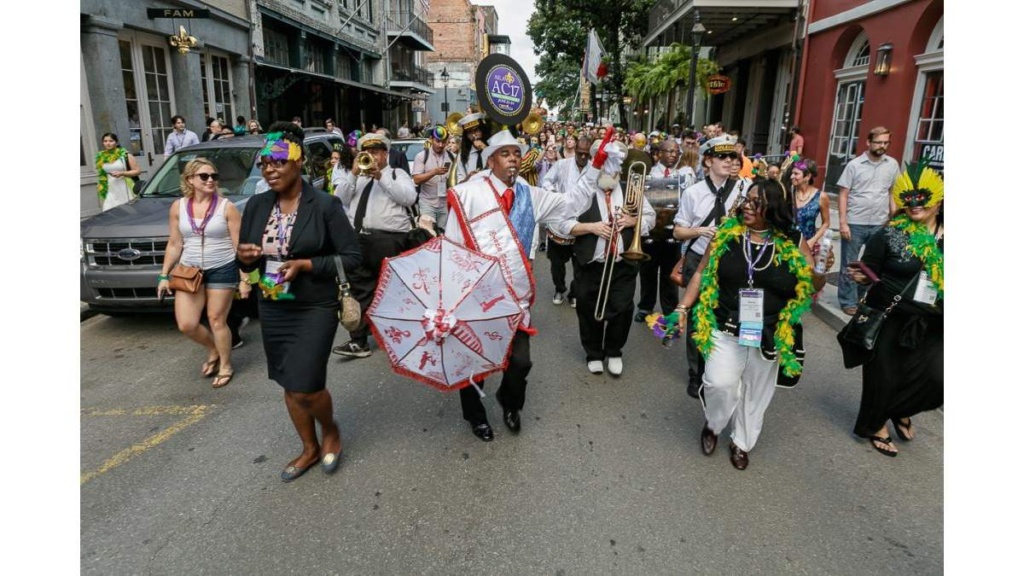
When you partner with experienced professionals like New Orleans Music Events, you get a team that’s managed events at scale, understands the cultural elements that make your gathering memorable, and will be on-site ensuring flawless execution.
Managing large corporate gatherings requires strategic planning, meticulous coordination, and experienced professionals who can handle complexity with confidence. Let’s build your next corporate event together. Learn more about our event management services
Frequently Asked Questions
What should a corporate event production plan include?
A comprehensive corporate event production plan covers venue logistics, vendor coordination, technical requirements, staff assignments, timeline milestones, contingency protocols, and post-event evaluation metrics. It details every element from load-in schedules to speaker coordination, audio-visual specifications, registration workflows, and on-site execution procedures. The plan should also address accessibility requirements, safety protocols, and communication channels for all stakeholders. A detailed plan reduces execution risks and ensures seamless delivery for large corporate gatherings.
How do you manage logistics for a large corporate event?
Logistics management for large events requires advance coordination with venue management, vendor selection, and detailed scheduling. Start by mapping all physical requirements: load-in times, equipment placement, attendee flow, and parking. Establish clear communication channels with all vendors and on-site teams. Create a master timeline that accounts for union requirements, technical setup, and contingency windows. Assign specific staff to each area and conduct pre-event walkthroughs. During the event, maintain real-time communication and adjust as needed. Post-event, document lessons learned for continuous improvement.
How do you create a contingency plan for a large corporate event?
Build contingency plans by identifying high-risk scenarios specific to your event: speaker no-shows, technical failures, weather disruptions, or vendor delays. For each risk, define trigger points, backup solutions, and responsible parties. Create alternative timelines and have backup vendors on standby. Document communication protocols for notifying stakeholders if contingencies activate. Test critical systems in advance and maintain equipment redundancy for essential functions. Brief your entire team on contingency procedures before event day. Strong contingency planning protects your brand reputation and ensures attendee satisfaction even when unexpected challenges arise.
How do you measure the success of a corporate event?
Measure event success through multiple metrics aligned with your business objectives. Track attendance rates, attendee satisfaction scores from post-event surveys, and engagement metrics such as session attendance and networking participation. For brand activation or product launches, measure lead generation, media mentions, and social media reach. Calculate return on investment by comparing event costs against tangible outcomes: sales pipeline value, partnership agreements, or employee retention improvements. Collect qualitative feedback through interviews and focus groups. Post-event reporting should compare actual results against pre-event goals and inform future event strategy.